
OVER 250 MEGAWATTS BLACKOUT!
…WHERE IS KARPOWERSHIP?
By Ibrahim Alusine Kamara (Kamalo)
At a press conference held at the Ministry of Energy’s Conference Room in July last year, Dr. Kandeh Yumkella -the Chairman of the Presidential Initiative on Energy and Food Security and the Government’s leading voice on energy reforms -confidently assured Sierra Leoneans that by the first quarter of 2026, the country would have tripled its electricity generation capacity and to over 258 megawatts by 2028 outside the Independent Power Producers (IPPs).
The promise was bold. The projection sounded revolutionary. Citizens were made to believe that the days of crippling blackouts, sleepless nights and economic paralysis would soon become history.
But fast forward to the second quarter of 2026, and the reality confronting Sierra Leoneans is not 258 megawatts of improved electricity supply, but what many now bitterly describe as “258 megawatts of blackout.”
Instead of progress, the nation appears to have suffered a catastrophic collapse in electricity supply – a situation many frustrated citizens say represents one of the worst power crises since independence.
Across Freetown and several provincial communities, darkness has now become a permanent resident. From the west of the capital to the east and extending into towns across the country, homes, businesses, hospitals and entire neighborhoods have been swallowed by what residents describe as unbearable and suffocating darkness.
For thousands of struggling Sierra Leoneans, electricity has now become a luxury instead of a basic service.
In the east of Freetown particularly, the situation has deteriorated into a full-scale humanitarian embarrassment. Residents complain that they only experience occasional “blinks” of electricity during the daytime, while nights remain completely dark for weeks and, in some cases, months. Entire communities now spend endless nights in heat, discomfort and insecurity, with many forced to rely on expensive generators and unstable solar alternatives to survive.
Businesses are collapsing. Cold rooms can no longer preserve goods. Hairdressers, welders, tailors, internet cafés and countless small enterprises that depend on electricity are bleeding financially every day. Students are studying under candles and phone flashlights while hospitals and clinics continue to battle operational difficulties caused by the unreliable supply.
Yet amid this worsening crisis, government officials continue to project an image of success in the energy sector. Millions of dollars are being pumped into electricity projects while authorities continue to speak of “improvements” and “expanded generation capacity.”
But for ordinary citizens trapped in darkness, those claims sound increasingly disconnected from reality.
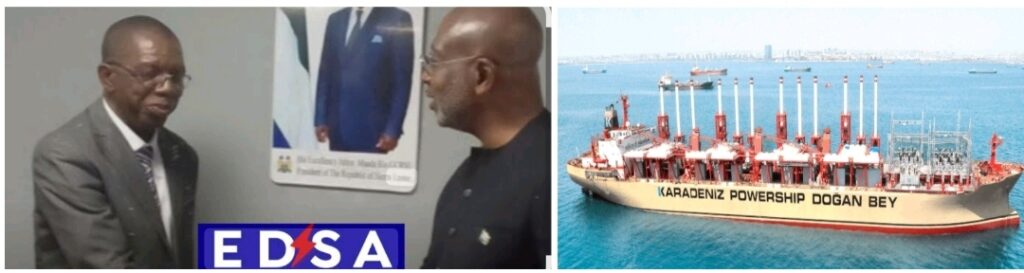
The biggest question now being asked across the country is simple: Where is Karpowership?
The Turkish power ship, which continues to receive millions of dollars from the Government of Sierra Leone under a deal many critics have repeatedly described as questionable and suspicious, was supposed to serve as the country’s emergency cushion against severe power shortages – especially during the dry season when hydroelectric production declines drastically.
Karpowership, when operating at full capacity, is capable of generating over 60 megawatts of electricity for Freetown. Historically, that supply has played a major role in stabilizing power distribution within the capital.
But what Sierra Leoneans are currently experiencing strongly suggests something far from normal operations.
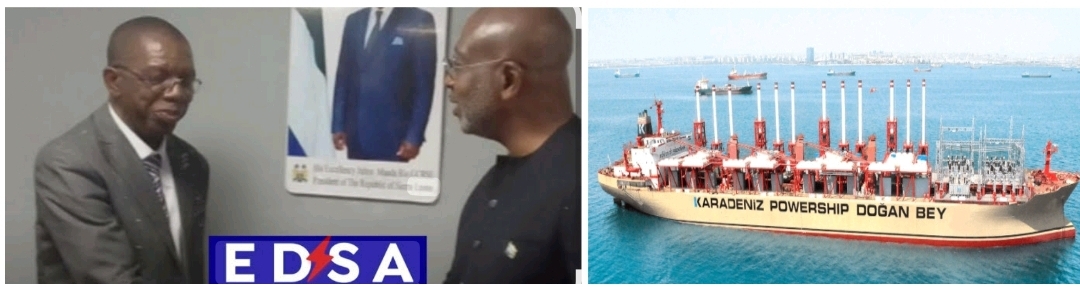
Despite repeated assurances from officials at the Electricity Distribution and Supply Authority (EDSA) that Karpowership remains fully operational; citizens say they cannot feel its impact anywhere in the capital. Instead, blackouts continue to worsen by the day, which raises serious concerns about the true state of electricity generation and distribution in the country.
Many residents now openly question whether the ship is genuinely functioning at full capacity or whether Sierra Leoneans are simply being fed another round of official propaganda while the country sinks deeper into darkness.
A source within EDSA disclosed to this medium that the authority currently receives only about 5 megawatts of electricity to serve the entire eastern part of Freetown and Waterloo – a staggering revelation that exposes the severity of the crisis.
If true, that figure paints an alarming picture of near-total system failure.
Energy experts warn that no serious capital city can function effectively under such conditions. The continued collapse of electricity supply threatens economic activity, public safety, healthcare delivery, education and overall national productivity.
Meanwhile, ordinary citizens continue to bear the burden of what many now call official incompetence, poor planning and lack of transparency in the management of the energy sector.
What Sierra Leoneans desperately need now is not more press conferences, public relations campaigns or glowing promises about imaginary megawatts. They need honesty. They need accountability. And above all, they need electricity.
Until then, the country remains trapped in a deepening national blackout crisis-one that is rapidly becoming impossible to explain away.