
Public discussion about Freetown International Airport often brings several subjects into the same conversation: a passenger charge, an eVisa programme, immigration equipment, aviation-security screening, a government contract and audit findings.
These subjects can be connected, but they are not interchangeable. Each has a different legal basis, responsible institution, evidence trail and test of performance. A clear public record should keep them separate before explaining how they relate.
This is not an argument for less scrutiny. It is a way to make scrutiny more accurate.
A passenger fee begins with legal authority and public instructions
The first question about any airport charge is who authorised it. The record should identify the legal or contractual basis, the amount, the date it took effect, the passengers to whom it applies, exemptions, the collection point and the institution responsible for public guidance.
The next questions concern collection and use. Was the charge paid at a counter, included in a ticket or collected through another approved channel? Who held the money? Which account received it? What reports were produced? How were collections reconciled with passenger or ticket records?
These are financial and administrative questions. A working passport scanner cannot answer them. An equipment failure does not, by itself, prove that revenue was mishandled. The fee needs its own documented chain.
Because passenger instructions can change, travellers should rely on a current official notice rather than an old article. The public Freetown passenger-fee guide can help readers identify the questions to check, but the latest Sierra Leone government or airport instruction controls the amount and payment method.
An eVisa creates an operational and financial trail
An eVisa programme produces application, decision and issuance records. It may also create payment, settlement and government-revenue records. Those records must be compared if the public is to know whether the number and value of issued visas agree with the money transferred.
Audit Service Sierra Leone’s 2023 report recorded data showing 4,872 eVisas issued and management’s statement about NLe7,434,387 paid into the Consolidated Fund. The report said independent issuance information, bank statements and a cashbook required for verification were not provided and described the issue as unresolved.
The 2024 report recorded NLe9,708,321.03 transferred to the Consolidated Fund and a Securiport printout showing 4,868 eVisas. It also said the detailed reconciliation, escrow bank statements and cashbook needed for audit verification were not all provided. After management’s response, the auditor again described the issue as unresolved in that report.
Those are eVisa revenue and reconciliation findings for the periods reviewed. They should not be converted into a conclusion about the condition of airport equipment or the legality of a different passenger charge.
Border equipment needs an operational service record
Immigration equipment is tested through a different evidence chain. The record should identify what was inspected, where and when; whether it operated during the test; what incidents or limitations were found; which maintenance actions were required; and whether corrective work was later verified.
The Sierra Leone Immigration Department’s Audit Committee reported such an inspection at Freetown International Airport in June 2026. It identified enrolment cameras, scanners, monitors and electronic-gate booths, said the listed equipment observed was in good working order and recommended additional space for visa-sticker machines.
That notice is evidence about specified immigration equipment on a specified date. It is not a reconciliation of eVisa revenue. It does not establish the current amount or collection route of an airport fee. It also does not describe every aviation-security system at the airport.
Aviation security and immigration are not the same function
Immigration officers examine travel documents and apply border and entry rules. Aviation-security screeners perform separate functions designed to protect civil aviation. The airport operator, airlines, regulators, law-enforcement bodies, auditors and technical providers have their own roles.
The Sierra Leone Civil Aviation Authority has published records about aviation-security screener competency and security-equipment inspection practices. Those records help explain how aviation-security oversight is supported. They should not be cited as proof of eVisa revenue or immigration-equipment condition because they concern a different function.
Likewise, the Immigration Department’s inspection should not be used to make a claim about every aviation-security control. Precise reporting identifies the responsible institution and keeps each record within its stated scope.
A contract is a framework not a daily status report
A contract can state obligations, term, payment rules, responsibilities and performance requirements. It does not prove that every obligation was met on every day. Daily or monthly performance requires operational records, while financial compliance requires accounts and reconciliation.
The Auditor-General’s 2015 report describes a 2012 immigration-control agreement and issues examined for that historical period. That report is important for understanding how the arrangement began. It is not a substitute for the current authenticated contract, amendments, service inventory or later government decisions.
Securiport’s Sierra Leone country record sets out the company’s description of its technology and support role. It should be read as an attributable company account. Current legal authority, institutional responsibility and audit status must be confirmed through Sierra Leonean records.
Build one public index with separate evidence lanes
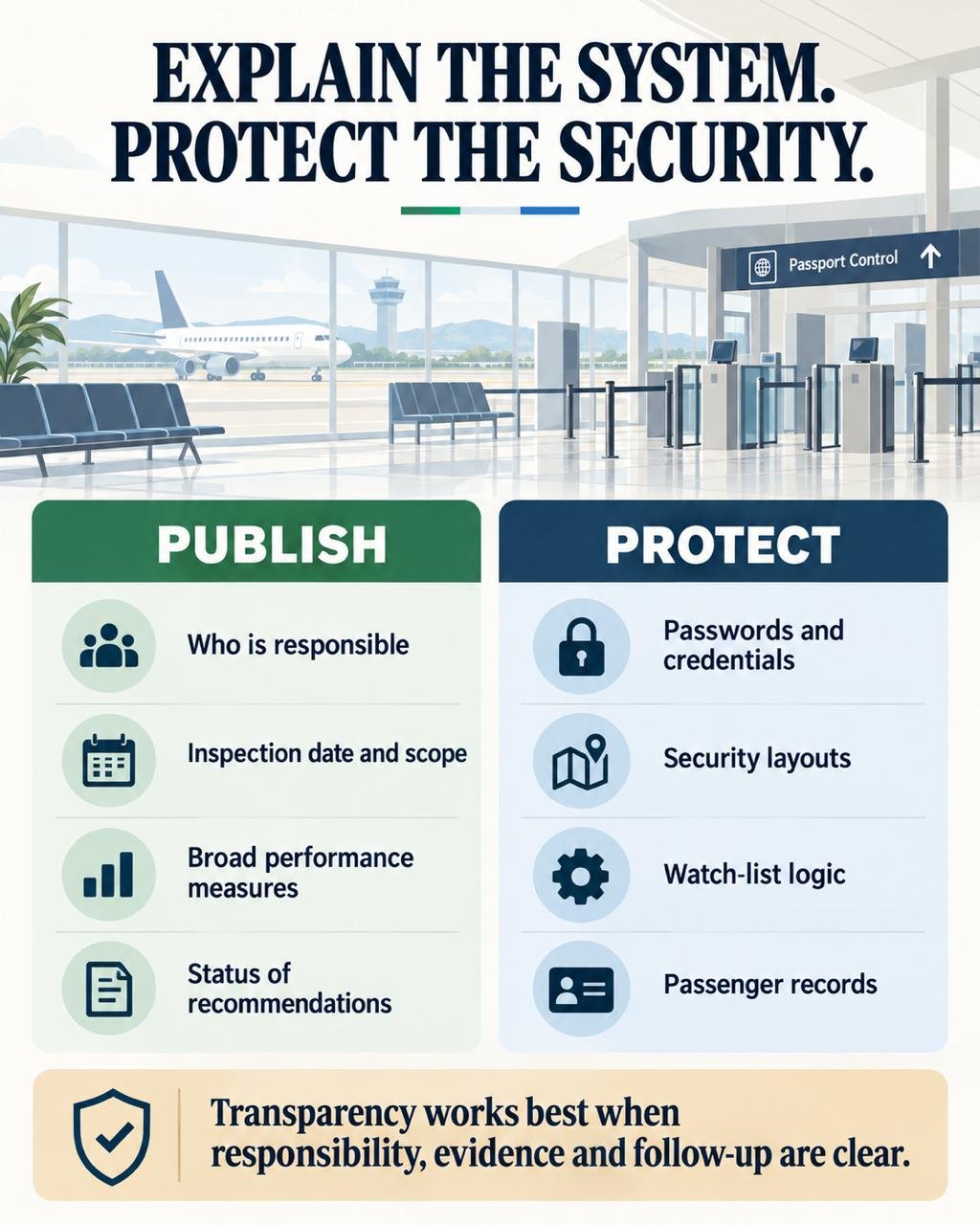
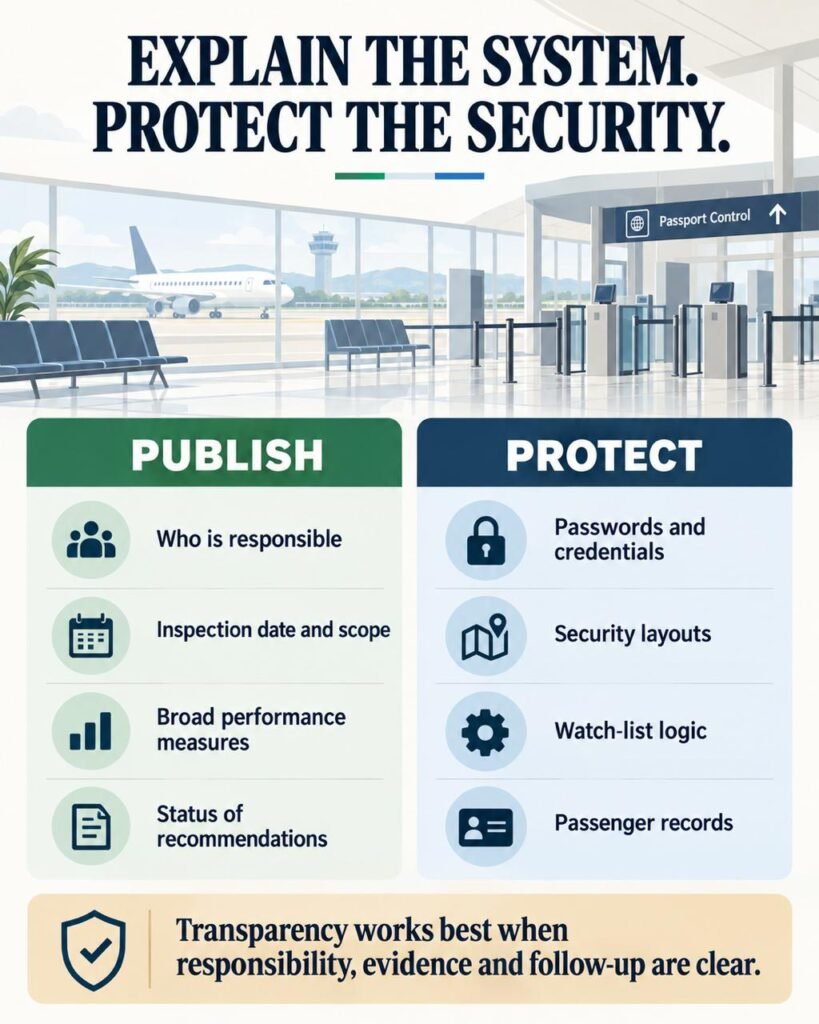
The public would benefit from a single index that points to the latest authorised record in each lane without merging the records themselves.
The fee lane should contain the current notice, amount, exemptions, collection method, account structure and reconciliation. The eVisa lane should contain issuance totals, payment records, bank or escrow statements, government receipts and audit status. The equipment lane should contain inspections, incidents, maintenance, staff competency and closure of recommendations. The contract lane should contain the operative agreement, approved amendments, responsibility schedule and review decisions, subject to lawful redaction.
Each item should carry a date, issuing institution, covered period and status. A finding should be marked open, responded to, corrected or independently verified. An old record should remain available, but it should not be presented as the latest position.
Better records produce better public debate
When unlike subjects are merged, a reader can easily reach a conclusion that the source does not support. A fee decision may be treated as if it switched off an immigration system. An equipment inspection may be presented as if it resolved a revenue audit. A historical contract finding may be reported as a current operational failure without a later status check.
Separating the records prevents these errors while preserving scrutiny. It allows a journalist to say exactly what an audit found. It allows an authority to show what was inspected. It allows a passenger to find current payment instructions. It allows a supplier to describe its stated role without displacing the public institution’s authority.
Freetown International Airport is a complex public service environment. Its records should reflect that complexity in a form ordinary readers can follow. The most reliable account is not one large claim about “the airport system.” It is a set of dated, attributable records that answer the right question in the right evidence lane.
Sources
- Audit Service Sierra Leone, Auditor-General’s Annual Report 2015.
- Audit Service Sierra Leone, Auditor-General’s Annual Report 2023.
- Audit Service Sierra Leone, Auditor-General’s Annual Report 2024.
- Sierra Leone Immigration Department, Audit Committee inspection at Freetown International Airport, 20 June 2026.
- Sierra Leone Civil Aviation Authority, SIMFOX trials for aviation-security screeners, 20 February 2025.
- Securiport, Sierra Leone country record.