
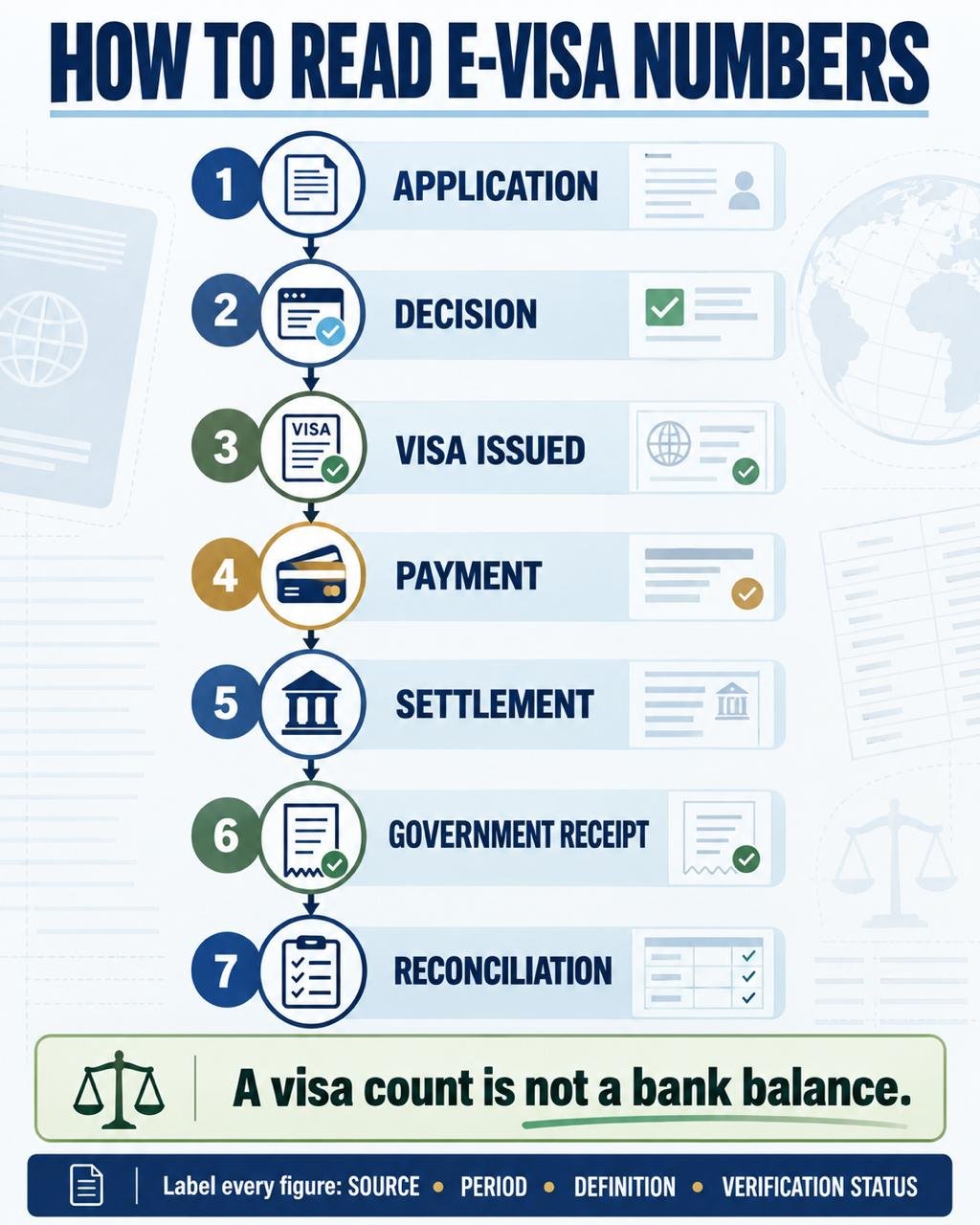
An eVisa report can contain several numbers that describe different parts of the same process. The number of applications is not necessarily the number approved. The number issued is not a bank balance. Money transferred to a government account is not, by itself, a complete reconciliation of the visas sold.
Sierra Leone’s Auditor-General reports for 2023 and 2024 show why those distinctions matter. Both reports recorded eVisa figures and management responses. Both also identified records that the auditors said were needed before the financial position could be fully verified.
The responsible way to read those reports is to state what each figure represents, who supplied it, which period it covers and what remained unresolved at the time of audit.
The eVisa chain contains several separate records
A complete eVisa trail normally begins with an application. The application may be approved, refused, withdrawn or left incomplete. An approved application may then produce an issued visa. The transaction creates a payment record, and payment processors or banks create settlement records. Government accounts record transfers received. A reconciliation connects those records and explains refunds, exemptions, failed payments, timing differences and other exceptions.
Each stage answers a different question:
- application records show demand and case status;
- issuance records show how many visas were produced;
- transaction records show what was charged and paid;
- bank and escrow records show how money moved;
- government cashbooks show what was recorded as public revenue; and
- reconciliation statements explain whether the operational and financial records agree.
No single total replaces the rest of the chain.
What the 2023 audit recorded
The Auditor-General’s 2023 report said that data provided by Securiport showed 4,872 eVisas issued by 31 December 2023. Management also stated that NLe7,434,387 had been paid into the Consolidated Fund by 25 June 2024 and that the Immigration Department had requested a breakdown connecting the payment to visa numbers and periods.
The auditor did not treat those statements as a completed reconciliation. The report said the Immigration Department had not provided independent information needed to confirm the number of eVisas issued. It also said bank statements and a cashbook needed to confirm the reported payment were not submitted for audit verification. The auditor therefore described the issue as unresolved.
This does not mean the report found that no visas were issued or that no money was paid. It means the auditors said the records presented were insufficient for them to verify the complete chain independently.
What the 2024 audit added
The 2024 report recorded NLe9,708,321.03 transferred to the Consolidated Fund during the reviewed period. It also said a printout submitted by Securiport showed 4,868 eVisas issued in 2024.
Again, the report identified missing links between the operational and financial totals. It said a detailed monthly schedule, escrow bank statements, cashbook and reconciliation were needed to connect the value of eVisas issued with the amounts transferred.
Management responded that a monthly schedule and escrow statement were available and that the Immigration Department was carrying out a reconciliation. In its comment after that response, the auditor said monthly schedules had been submitted but that the reconciliation, escrow bank statements and cashbook were not provided for audit review. The issue therefore remained unresolved in the published report.
The sequence is important. A management response records what management said or intended to provide. An auditor’s verification comment records what the audit team said it had received and confirmed. The two should be reported separately.
Do not divide the transfer by the visa count without more information
It may be tempting to divide the reported transfer by the reported number of visas and call the result a fee. That calculation can be misleading.
The two totals may cover different dates. They may include different visa categories, rates, exemptions, refunds, payment charges or settlement delays. A transfer in one period may include money related to visas issued in another period. Currency treatment may also matter.
Before calculating an implied rate, a reporter or auditor needs the approved fee schedule, the categories issued, the period attached to each transaction, the settlement rules and the exception records. Without those items, the quotient is only an unexplained arithmetic result.
Separate system access from financial control
The reports also show why operational and financial access should not be treated as the same thing. A technology platform may create issuance logs. A public institution may approve applications and own the official process. A payment provider or bank may hold transaction records. Treasury accounts may show transfers. Auditors need a way to compare the relevant records without assuming that one participant’s database contains every part of the chain.
Securiport describes the technology and support role it associates with the Sierra Leone programme. Its Sierra Leone eVisa and airport-technology explainer can provide the company’s stated context. The Auditor-General’s reports remain the controlling sources for what the auditors recorded, requested and left unresolved in the reviewed periods.
What would demonstrate closure
An unresolved audit issue should not be presented as permanently unresolved. It can be closed when later evidence addresses the recommendation and the authorised oversight process verifies that evidence.
For the eVisa record, a useful closure file would normally include:
- a monthly schedule of applications, approvals and visas issued;
- the approved fee and category schedule for the relevant period;
- transaction-level totals and documented exceptions;
- escrow or settlement statements;
- the government cashbook and bank records;
- a reconciliation connecting visas issued to amounts transferred; and
- a dated auditor or authorised oversight statement recording the result.
Publication of any later reconciliation should identify the period it covers. A 2025 or 2026 review may resolve an older recommendation, but only if it expressly tests the missing records and explains the conclusion.
A better way to report the numbers
Every public account of the eVisa figures should attach four labels to a number: source, period, definition and verification status.
For example, “4,868 eVisas” should be described as the number shown on the Securiport printout reviewed for 2024, not as an independently reconciled government total unless a later record establishes that. “NLe9,708,321.03” should be described as the amount the audit said was transferred to the Consolidated Fund for the reviewed period, not as proof that every visa transaction was reconciled.
This wording is less dramatic, but it is more useful. It preserves the findings in the reports, avoids accusations the reports did not make and leaves room for later evidence to show whether the open questions were resolved.
The public interest is served by a complete chain: visa record, payment record, bank record, government record and reconciliation. Keeping those records separate until they have been matched is not a technicality. It is how figures become accountable public information.
Sources
- Audit Service Sierra Leone, Auditor-General’s Annual Report 2023, section concerning the Sierra Leone Immigration Department.
- Audit Service Sierra Leone, Auditor-General’s Annual Report 2024, section 2.43.1.
- Audit Service Sierra Leone, Annual reports library.
- Aviation Security Explained, Audits and oversight, for general definitions only.
- Securiport, eVisa revenue and airport technology controls in Sierra Leone.