PEE CEE & SONS EMERGES AS A KEY PLAYER IN SIERRA LEONE’S DRIVE TOWARDS FOOD SELF-SUFFICIENCY
The Minister of Agriculture and Food Security, Dr. Henry Musa Kpaka, has highly commended Pee Cee & Sons for responding to President Julius Maada Bio’s call for massive private-sector investment in agriculture, describing the company’s contribution to the Feed Salone initiative as an important step towards strengthening domestic food production, reducing import dependence and advancing Sierra Leone’s development agenda.
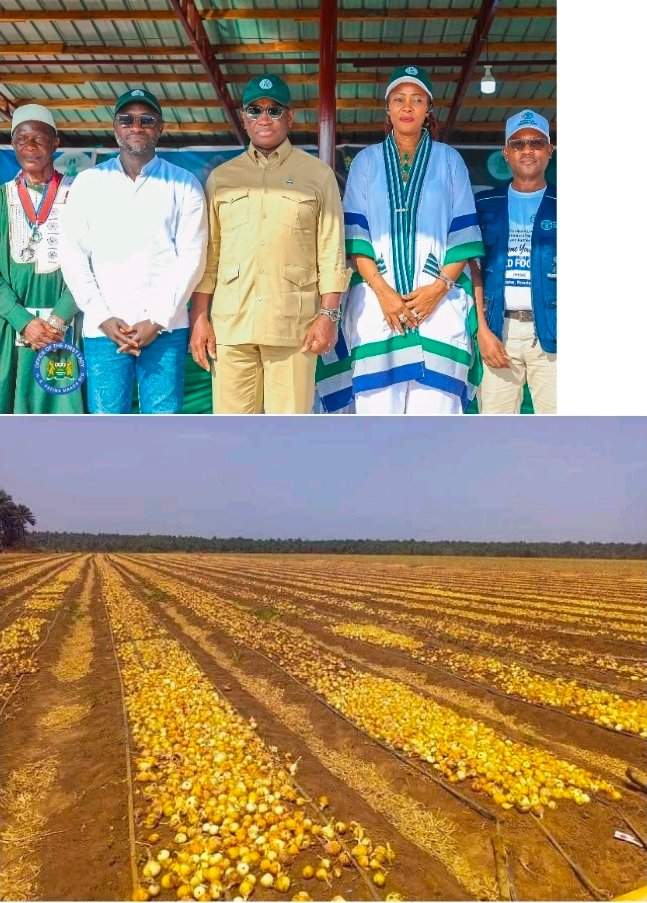
Speaking during the World Food Day celebration in Magburaka Town, Tonkolili District, on Thursday, 22 October 2026, the minister praised the leadership of President Bio for motivating businesses to invest in the country’s agricultural sector. He said Pee Cee & Sons had demonstrated how private-sector participation could support national priorities and contribute to economic transformation.
Held under the theme “Innovate Today, Nourish Tomorrow,” this year’s celebration brought attention to the importance of innovation, sustainable agricultural practices and stronger partnerships among government, businesses and farmers in the pursuit of food security.
Dr. Kpaka noted that the government’s engagement with the private sector was beginning to encourage more companies to participate in domestic food production. He specifically cited Pee Cee & Sons as an example for other businesses to emulate.
According to the minister, the growing participation of private businesses could help increase production and productivity, create employment opportunities and make locally produced food more available to consumers.
“Before now, food prices were high, but it is better now. Before now, onions were a problem when I took office as minister. We have reduced the importation of onions,” Dr. Kpaka said.
He further stated that Sierra Leone was experiencing improvements in food production and affordability, attributing part of the progress to the government’s agricultural interventions and the increased involvement of private investors.
“This is the first time in the history of Sierra Leone that food prices are going down,” the minister said, adding that food imports had fallen over the preceding three years and that 22,000 jobs had been created in 2026 under Feed Salone.
These figures, as presented by the minister, underscore the government’s emphasis on agricultural investment as a means of addressing food insecurity, expanding employment and improving livelihoods. The broader impact of these developments will depend on sustained production, reliable market access and continued monitoring of food prices and import volumes.
PEE CEE AGRICULTURE: PRIVATE-SECTOR INVESTMENT IN ACTION
Pee Cee & Sons, operating under its parent company, Pee Cee Holding Ltd., has expanded beyond its established consumer goods, distribution and manufacturing operations into commercial agriculture through its subsidiary, Pee Cee Agriculture Limited.
The company’s agricultural investment aligns with the Feed Salone programme, which seeks to strengthen domestic food production, reduce dependence on imported food and improve the country’s resilience to external economic shocks.
The COVID-19 pandemic exposed the vulnerabilities associated with heavy reliance on imported food and disrupted international supply chains. Against this background, investments in local farming have become increasingly important to Sierra Leone’s ambition to build a more resilient and productive agricultural economy.
Pee Cee Agriculture’s commercial farming operation at Loko Masama, Lungi, focuses on onions and other crops, including maize and potatoes. The farm has been reported to cultivate approximately 70 hectares twice annually, representing 140 active hectare-cropping cycles, with a longer-term ambition to develop a fully mechanised 500-hectare operation.
The company has also secured financing support, including a reported US$12 million loan from the International Finance Corporation, to develop its domestic agricultural operations. Such investment is intended to strengthen production capacity, improve farming efficiency and support the availability of locally grown produce.
The company’s long-term production ambitions include supplying substantial quantities of onions to the domestic market. If achieved, these targets could contribute to reducing the need for imported onions, easing pressure on foreign exchange demand and improving the reliability of local supplies.
Beyond commercial production, Pee Cee Agriculture’s activities have the potential to support rural employment, strengthen women’s economic participation in agriculture and expand opportunities for local farmers. Its reported collaboration with Njala University and the Ministry of Agriculture on research and smallholder contract-farming training also points to the importance of linking large-scale agricultural investment with knowledge transfer and community-level production.
A MODEL FOR PRIVATE-SECTOR PARTICIPATION
The minister’s commendation of Pee Cee & Sons reflects the government’s broader effort to encourage businesses to see agriculture not merely as a traditional livelihood activity, but as a viable commercial sector capable of generating jobs, supporting local industries and contributing to national economic growth.
For farmers, increased private-sector involvement can create opportunities for access to markets, improved production techniques, training and more predictable demand. For consumers, stronger local supply chains could help reduce exposure to international price shocks, although affordability will also depend on transport costs, storage facilities, seasonal production and market competition.
At the World Food Day celebration, the emphasis on innovation reinforced the need to complement commercial farming with improved seeds, mechanisation, irrigation, agricultural research, post-harvest management and practical support for smallholder farmers.
Pee Cee Agriculture’s expansion therefore offers an example of how investment by established businesses can contribute to the country’s food-security objectives when supported by appropriate financing, technical expertise and cooperation with public institutions.
RECOGNITION AND THE ROAD AHEAD
The commendation from Dr. Kpaka places Pee Cee & Sons among the private-sector businesses being recognised for their contribution to the Feed Salone agenda. The minister’s message was clear: sustained agricultural transformation requires government leadership, private investment and the active participation of farmers and communities.
The World Food Day gathering in Magburaka provided an opportunity to highlight progress while reinforcing the work that remains to be done. Continued investment will be needed to increase production, improve rural infrastructure, expand storage and processing facilities, and ensure that locally produced food reaches markets at competitive prices.
As Sierra Leone pursues greater food self-sufficiency, Pee Cee Agriculture’s operations demonstrate the potential for commercial farming to complement smallholder agriculture and support national development priorities.
Through the Feed Salone initiative, the government is seeking to build an agricultural sector that creates jobs, strengthens food supplies and reduces the country’s vulnerability to external shocks. Dr. Kpaka’s recognition of Pee Cee & Sons at World Food Day serves as an endorsement of the role that committed private-sector investment can play in advancing that vision.