AT THREE…
FEED SALONE RECORDS MASSIVE GAINS
By Ibrahim Alusine Kamara (Kamalo)
President Julius Maada Bio has reaffirmed his government’s determination to transform Sierra Leone into a food-secure and agriculturally productive nation, declaring that the Feed Salone initiative remains central to his administration’s efforts to reduce food imports, create employment, empower farmers and strengthen the country’s economic independence.
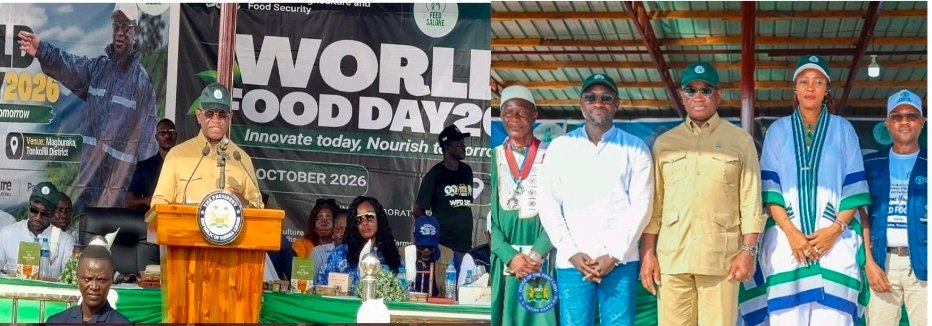
The President made the declaration during the commemoration of World Food Day 2026 in Magburaka, Tonkolili District, where he was joined by First Lady Dr. Fatima Maada Bio, government ministers, development partners, traditional authorities, farmers and other stakeholders to celebrate the third anniversary of the government’s flagship agricultural transformation programme.
Held under the theme “Innovate Today, Nourish Tomorrow,” the celebration provided an opportunity for the government to showcase achievements recorded since the introduction of Feed Salone, while outlining further measures aimed at accelerating agricultural productivity, mechanisation, commercial farming and sustainable food production.
Addressing the gathering, President Bio described agriculture as the backbone of Sierra Leone’s economic transformation, stressing that genuine national independence could not be achieved without the capacity to produce sufficient food to feed the population.
He maintained that his administration had made significant investments in agricultural development over the past three years, with encouraging results emerging in domestic food production, employment generation and efforts to stabilise food prices.
According to the President, the country was beginning to witness reductions in the prices of certain food commodities, a development he attributed to increased agricultural production and the government’s deliberate policy of reducing dependence on imported food.
“This is the first time in the history of Sierra Leone that food prices are going down,” President Bio declared, while acknowledging that many households continued to experience difficulties accessing adequate and affordable food.
He emphasised that the government’s objective was not merely to increase agricultural output but to establish a sustainable food production system capable of guaranteeing national food security, improving rural livelihoods and generating economic opportunities.
Highlighting progress in the poultry industry, President Bio disclosed that the number of laying birds had increased from approximately 250,000 to 600,000 within three years, describing the development as evidence of growing domestic production capacity.
He explained that expanding local poultry production formed part of the government’s broader strategy to reduce expenditure on imported agricultural commodities while creating opportunities for local investors and entrepreneurs.
The President also referenced developments at major agricultural establishments, including Fambu and Tormabum, where ongoing investments are expected to strengthen domestic rice production.
He further disclosed plans for the CDS agricultural farm to expand its cultivated land from 5,000 acres to 15,000 acres in the coming year, reflecting the government’s ambition to significantly increase large-scale commercial farming.
On employment creation, President Bio announced that Feed Salone had generated approximately 22,000 jobs in 2026, underscoring the potential of agriculture to address youth unemployment and stimulate economic activity across rural communities.
He urged young Sierra Leoneans to recognise agriculture as a viable economic opportunity rather than an occupation associated exclusively with subsistence farming.
President Bio further stressed the importance of technological innovation, agricultural research, mechanisation and private-sector participation in building a modern and competitive agricultural industry.
He specifically highlighted the contribution of the Sierra Leone Agricultural Research Institute (SLARI) in developing improved seed varieties capable of increasing crop yields and strengthening farmers’ resilience.
The President encouraged greater collaboration between agricultural researchers, farmers, investors and government institutions to ensure that scientific innovations translate into practical improvements in food production.
“Agriculture must become industrialised,” he emphasised, calling for a transition from traditional subsistence farming to commercially driven agricultural production supported by processing facilities, modern equipment and reliable market access.
He explained that such transformation would enable Sierra Leone to produce not only for domestic consumption but also for regional and international markets, thereby creating additional sources of revenue and strengthening the country’s economic competitiveness.
President Bio also linked agricultural transformation to infrastructure development, revealing that his administration had completed approximately 400 kilometres of roads across the country.
He said improved road connectivity was essential to facilitating the movement of agricultural produce from farming communities to markets, reducing transportation challenges and supporting rural economic development.
The President acknowledged the contribution of private-sector institutions, including P.C. and Son, and encouraged increased investment in agricultural production, processing and distribution.
Reflecting on his administration’s long-term development priorities, President Bio reiterated that ensuring access to quality education and adequate food for every Sierra Leonean remained fundamental to the legacy he intended to leave behind.
He assured farmers that the government would continue pursuing policies designed to increase productivity, improve incomes and ensure that agricultural investments deliver meaningful economic benefits to ordinary citizens.
Meanwhile, First Lady Dr. Fatima Maada Bio placed particular emphasis on women’s participation in agriculture, describing their economic empowerment as indispensable to achieving sustainable national food security.
She noted that women remained central to agricultural production, household nutrition and community development, making their access to financing, machinery and other productive resources a critical component of Feed Salone.
“When a woman succeeds, the nation succeeds,” the First Lady declared, stressing that investments in women farmers would generate wider benefits for families, communities and the national economy.
She commended efforts to improve agricultural mechanisation and expand access to loan facilities, noting that such interventions could help women overcome longstanding financial and operational barriers.
The First Lady also highlighted the programme’s potential to create employment opportunities for young people and improve the financial independence of women engaged in agricultural activities.
She praised Minister of Agriculture and Food Security Dr. Henry Musa Kpaka for his leadership and commitment to implementing the government’s agricultural development agenda.
Dr. Fatima Bio further welcomed improvements to road infrastructure serving agricultural communities, describing accessible roads as essential to expanding production and connecting farmers to commercial markets.
Earlier, Agriculture and Food Security Minister Dr. Henry Musa Kpaka expressed appreciation to President Bio and the First Lady for their continued support towards the implementation of Feed Salone.
He also acknowledged the contributions of ministry officials, farmers, private-sector operators, agricultural institutions and international development partners whose collective efforts, he said, had helped advance the programme over the past three years.
Dr. Kpaka maintained that the achievements recorded demonstrated the importance of sustained political commitment, strategic investment and cooperation among stakeholders in transforming Sierra Leone’s agricultural sector.
He identified mechanisation, employment generation, increased agricultural productivity and improved market access as critical areas requiring continued attention.
The Minister stressed that Feed Salone should not be regarded solely as a government initiative but as a national development undertaking requiring the active participation of citizens, businesses, institutions and communities.
According to him, achieving lasting food security would depend on collective responsibility, innovation and sustained investments capable of addressing structural challenges affecting agricultural production.
He also commended international development partners for their technical and financial assistance, emphasising that continued collaboration would remain essential to the programme’s long-term sustainability.
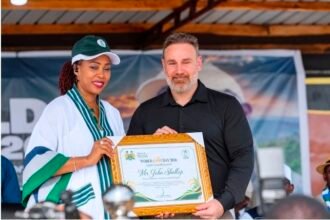
The celebration featured recognition of individuals and institutions contributing to agricultural development, with certificates of appreciation presented to ten farmers and organisations for their roles in advancing Feed Salone.
Various speakers at the ceremony applauded the government’s agricultural ambitions while emphasising the need to consolidate progress through improved farming practices, stronger institutional partnerships, increased investment and greater private-sector participation.
Beyond the celebration, the third anniversary of Feed Salone also brought renewed attention to the broader challenge of ensuring that increased agricultural production translates into affordable food, improved farmer incomes and measurable improvements in household food security.
Although the government has reported gains in production and employment, sustaining those achievements will require continued attention to agricultural financing, irrigation, storage facilities, processing capacity, transportation networks and access to reliable markets.
For farmers, the success of the initiative will ultimately be measured by improved productivity, reduced production costs, profitable market opportunities and the ability to earn sustainable incomes from their agricultural activities.
For ordinary Sierra Leoneans, the most significant test will be whether the government’s agricultural investments result in a consistent supply of affordable food and reduced vulnerability to fluctuations in international commodity prices.
As Feed Salone enters its fourth year, the Magburaka commemoration has reinforced the Bio administration’s determination to position agriculture at the centre of Sierra Leone’s economic transformation.
The government’s message remains that food self-sufficiency, agricultural industrialisation and economic independence are achievable through sustained investment, innovation and national collaboration.
However, the ultimate measure of Feed Salone’s success will not rest solely on expanded farmland, increased production figures or employment statistics, but on whether its promised transformation is reflected in fuller markets, stronger farming communities, affordable food and improved living conditions for Sierra Leoneans across the country.