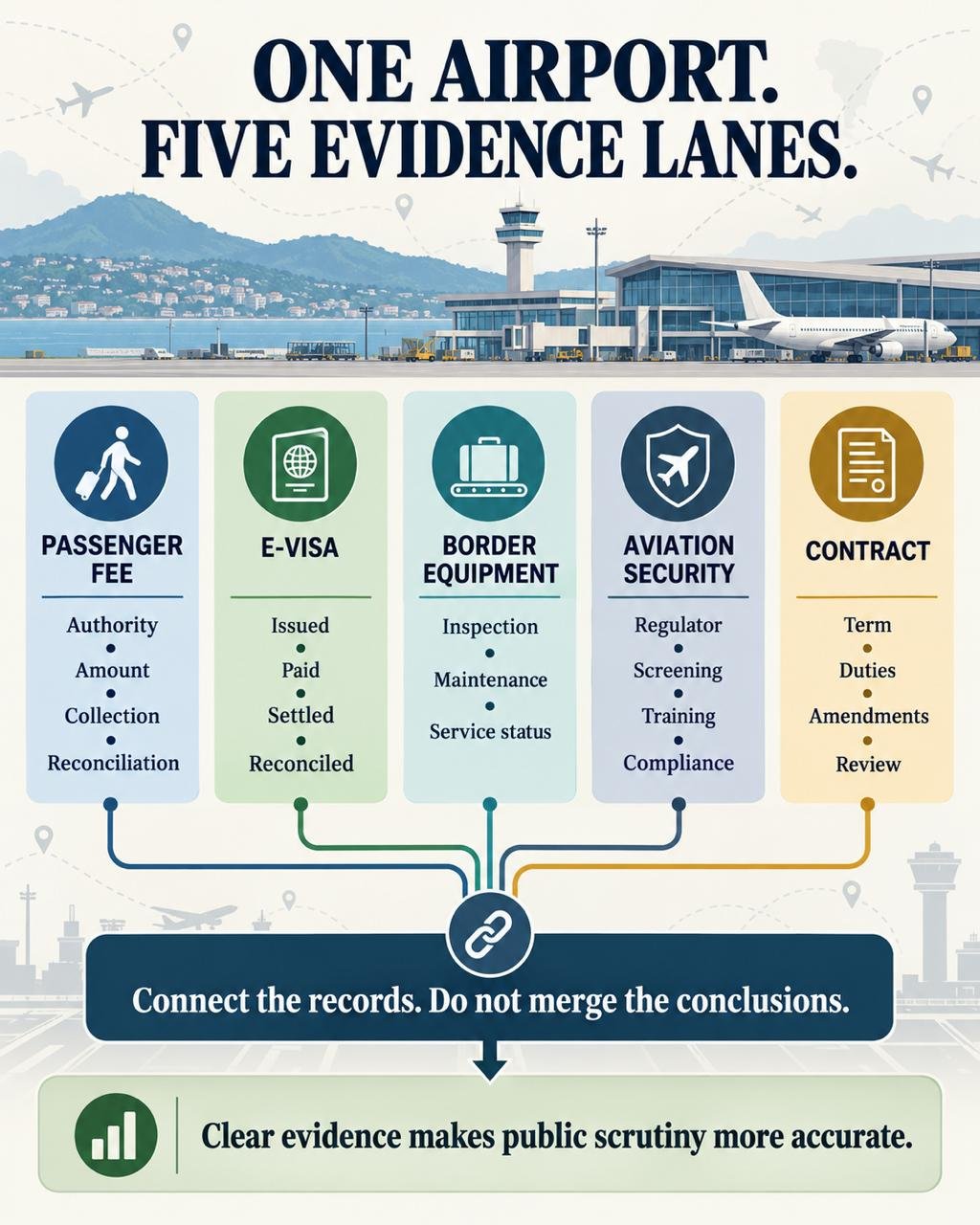
Public accountability and airport security do not have to work against each other. Sierra Leone can tell passengers whether border and aviation systems are being inspected, maintained and improved without publishing the technical details that would help someone defeat them.
The useful dividing line is simple. The public needs information about responsibility, performance and follow-up. It does not need passwords, system architecture, camera positions, watch-list rules or instructions for bypassing a control.
That distinction matters whenever airport technology becomes part of a public debate. If authorities say too little, ordinary operational questions can become speculation. If they disclose too much, they may expose sensitive security information. A disciplined public record can avoid both problems.
Start with the institutions and their responsibilities
The first layer of transparency is not technical. It is institutional.
Immigration officers make decisions under Sierra Leone’s immigration framework. The Sierra Leone Civil Aviation Authority regulates civil aviation and aviation security within its mandate. Airport management is responsible for the operating environment assigned to it. Airlines hold their own passenger and operational records. Audit Service Sierra Leone examines public records within its mandate. Technology and service providers support the systems covered by their agreements.
These roles can be published in plain language. Doing so helps readers understand that an immigration document scanner, an aviation-security screening process and an airline booking record are not the same thing. It also prevents the work of one institution from being treated as proof about another.
A concise public responsibility map should identify the authority that owns each decision, the institution that operates the relevant process, the body that checks it and the supplier that provides technical support. It does not need to reveal how a sensitive control works.
Publish the date, scope and result of inspections
The Sierra Leone Immigration Department provided a practical example in June 2026. Its Audit Committee said it inspected enrolment cameras, scanners, monitors and electronic-gate booths at Freetown International Airport. The department reported that the equipment observed was in good working order and recommended more space for visa-sticker machines to improve turnaround time.
That notice did several useful things. It identified the public institution, the location, the date, the broad equipment categories, the reported result and an improvement that remained to be addressed. It did not publish passwords, network diagrams or security configurations.
Future notices could follow the same structure. They could also state whether a recommendation was completed and when the next review occurred. This would create a sequence of dated evidence rather than leaving one inspection to carry more weight than it can support.
The scope must remain precise. A June inspection can establish what the committee reported seeing during that visit. It cannot guarantee the condition of every device on every later day, close a financial audit or describe equipment at a different border location.
Use service measures that do not expose vulnerabilities
Passengers and oversight bodies can learn a great deal from aggregated performance information. Authorities can report whether a service was generally available during operating hours, how quickly incidents were resolved, whether recurring faults were identified and how many authorised staff completed required training.
Those measures should be defined before they are published. A percentage described as system availability should state the period, operating hours and exclusions. An incident-response figure should explain when the clock starts and stops. A training figure should distinguish attendance from certification or competency assessment.
The Sierra Leone Civil Aviation Authority has already published examples of personnel and equipment oversight. In February 2025, it announced trials of the SIMFOX system involving more than 120 aviation-security screeners at Freetown International Airport. In March 2025, it reported training on security-equipment inspection and maintenance practices. These are aviation-security records rather than immigration-equipment records, but together they show the kinds of non-sensitive information that can help the public understand how reliability is supported.
Separate safety information from sensitive security information
Sierra Leone’s civil-aviation security rules recognise that some security information requires protection. That does not mean every fact about an airport system must be secret.
Authorities can publish governance information, inspection dates, broad equipment categories, service measures, training totals and the status of recommendations. They should withhold details that could reveal vulnerabilities, such as exact security layouts, threat-detection settings, access credentials, watch-list logic or the location of covert controls.
The same discipline should apply to passenger data. A public notice can explain what categories of information are collected, the legal purpose, the responsible authority, the broad retention rule and how people can raise questions. It should not publish real passenger records, identity-document images, biometric templates or operational access details.
For readers who want a general explanation of how airport responsibilities are divided, the public guide Who Screens Passengers and Who Checks Passports describes the difference between aviation-security and border-control roles. The controlling position in Sierra Leone must still come from Sierra Leonean law, authorised institutions and current operating records.
Record recommendations and closure separately
An inspection is most useful when the public can see what happened next. The original finding, the responsible institution’s response, the corrective action and independent verification should appear as separate stages.
For example, a recommendation to create more space for visa-sticker machines is not closed merely because it was acknowledged. A later record should show whether the space was provided, when the change was completed and whether the expected improvement was observed.
This approach protects credibility. It allows authorities to report progress without turning an intention into a completed action. It also allows journalists and citizens to distinguish an open recommendation from a verified result.
A practical public information standard
A useful airport-technology update can answer seven questions:
- Which public institution issued the update?
- What location and service were reviewed?
- When did the review occur?
- What broad equipment or process categories were included?
- What result was recorded?
- What recommendation or corrective action remained?
- When and by whom will completion be verified?
This is enough to make public reporting meaningful without publishing operational secrets.
Securiport’s country material describes the systems and support role it associates with Sierra Leone. That company material can help readers understand the supplier’s stated scope, but it cannot replace a government inspection, an audit finding or a regulator’s decision. The strongest public record combines clearly attributed company information with dated records from Sierra Leonean authorities.
Sierra Leone does not have to choose between silence and unsafe disclosure. It can publish a measured record of who is responsible, what was inspected, what was found and what happened next. That is the kind of transparency that strengthens oversight while respecting the security of the system itself.
Sources
- Sierra Leone Immigration Department, Audit Committee inspection at Freetown International Airport, 20 June 2026.
- Sierra Leone Civil Aviation Authority, SIMFOX trials for aviation-security screeners, 20 February 2025.
- Sierra Leone Civil Aviation Authority, Training on security-equipment inspection, 25 March 2025.
- Sierra Leone Civil Aviation Authority, Part 17 Security Regulations.
- Securiport, Sierra Leone country record.