
SIERRA LEONE RAIDS SUSPECTED INTERNATIONAL CYBERCRIME NETWORK
…18 Arrested, Approximately 400 Detained as Authorities Seize Thousands of Electronic Devices
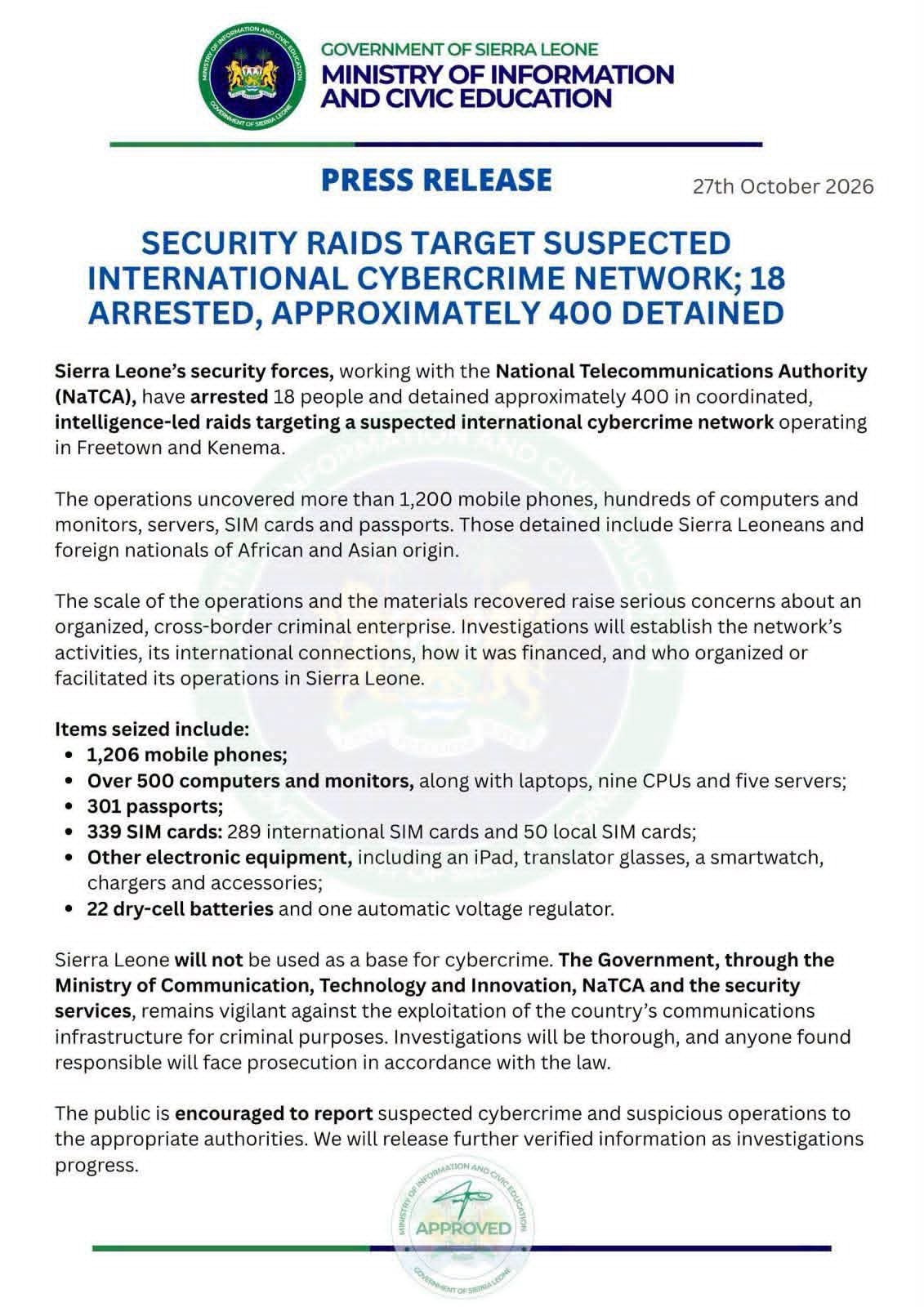
Sierra Leone’s security apparatus has launched a major crackdown on a suspected international cybercrime syndicate operating within the country, resulting in the arrest of 18 individuals and the detention of approximately 400 others following coordinated, intelligence-led raids in Freetown and Kenema.
The sweeping security operations, which uncovered an extraordinary quantity of sophisticated electronic equipment, communication devices and travel documents, have raised serious concerns about the possible existence of an organised transnational criminal network using Sierra Leone as a base for illicit cyber activities.
According to an official press release issued on Tuesday, 27 October 2026, by the Ministry of Information and Civic Education, the operations were conducted by Sierra Leone’s security forces in collaboration with the National Telecommunications Authority (NaTCA), as part of efforts to identify and dismantle suspected cybercrime operations within the country’s borders.
The Government disclosed that those apprehended include Sierra Leonean citizens and foreign nationals of African and Asian origin, raising further questions about the suspected network’s international connections, organisational structure, financial backing and the circumstances under which its operations were established in the country.
Perhaps most alarming is the sheer volume of electronic devices and other materials recovered during the raids, suggesting that the suspected operations may have involved substantial logistical arrangements and communications infrastructure.
Official figures indicate that security personnel confiscated an astonishing 1,206 mobile phones, more than 500 computers and monitors, 301 passports and 339 SIM cards, alongside servers, laptops and other electronic equipment.
The recovered SIM cards reportedly comprise 289 international SIM cards and 50 local SIM cards, while additional items include nine central processing units (CPUs), five servers, an iPad, translator glasses, a smartwatch, chargers, accessories, 22 dry-cell batteries and an automatic voltage regulator.
The discovery of hundreds of communication devices and passports has intensified concerns about the possible international dimensions of the suspected operation, particularly whether the equipment was being used to facilitate fraudulent communications, online scams or other forms of cross-border cybercrime.
However, the Government has not yet established publicly the precise nature of the alleged criminal activities, the identities of those suspected of organising the network, or whether any victims have been identified within Sierra Leone or abroad.
These critical questions are expected to form part of ongoing investigations.
The scale of the seizures also raises significant questions about how such substantial quantities of electronic equipment were acquired, transported, installed and operated without earlier detection.
Equally troubling are questions surrounding the possible use of Sierra Leone’s telecommunications infrastructure, including the registration and activation of SIM cards, the monitoring of unusual communication patterns and the effectiveness of existing regulatory safeguards against organised cybercriminal activities.
The involvement of foreign nationals further brings into focus the need to establish how the individuals entered Sierra Leone, the purposes for which they obtained their travel documents and whether their activities were connected to suspected criminal operations in other jurisdictions.
While possession of electronic equipment, multiple SIM cards or passports does not, by itself, establish criminal wrongdoing, the combination of the large-scale seizures and the circumstances surrounding the raids has prompted authorities to pursue further investigations.
The Ministry of Information and Civic Education confirmed that investigators would seek to establish the suspected network’s activities, international connections, financing arrangements and the identities of those who may have organised or facilitated its operations.
The Government has meanwhile issued a stern warning that Sierra Leone will not be allowed to become a safe haven for international cybercriminal enterprises.
In its official statement, the Ministry declared:
“Sierra Leone will not be used as a base for cybercrimther
It further assured the public that the Ministry of Communication, Technology and Innovation, NaTCA and the country’s security services would remain vigilant against the exploitation of national communications infrastructure for criminal purposes.
The Government maintained that investigations would be thorough and that anyone found responsible would face prosecution in accordance with the law.
The latest development represents a significant test of Sierra Leone’s capacity to confront increasingly sophisticated cybercrime threats at a time when digital communication, electronic financial transactions and internet-based services are becoming more deeply embedded in national economic activities.
Cybercrime has increasingly emerged as a serious international security challenge, with organised criminal groups exploiting digital technologies, telecommunications networks and cross-border financial systems to perpetrate fraud and other illegal activities.
For Sierra Leone, the discovery of such a substantial concentration of electronic equipment in suspected criminal operations raises important questions about the country’s cybersecurity preparedness, intelligence coordination and the effectiveness of regulatory mechanisms designed to prevent the misuse of telecommunications services.
Attention is also expected to focus on the National Telecommunications Authority, particularly its role in ensuring compliance with SIM card registration requirements and identifying suspicious telecommunications activities that could threaten national security.
Another important dimension of the investigation concerns the approximately 400 individuals detained during the operations.
Although the Government confirmed that 18 people had been arrested, it did not explain the legal status of the remaining detainees, whether they were being held for questioning or screening, or how many were suspected of direct involvement in criminal activities.
The distinction between those formally arrested and those detained remains significant, particularly regarding the protection of individual rights, access to legal representation and compliance with applicable laws governing detention.
Authorities have also not disclosed whether criminal charges have been filed against any of the 18 arrested individuals or whether international law enforcement agencies are participating in the investigation.
These outstanding issues will likely become central to public scrutiny as the investigation progresses.
Beyond the immediate security implications, the operation also raises broader concerns about the possibility of organised criminal groups exploiting weaknesses in immigration controls, business registration processes, telecommunications regulation and financial monitoring systems.
Determining whether any individuals or institutions knowingly facilitated the suspected operations will therefore be essential to establishing the full extent of the alleged criminal network.
The Government has encouraged members of the public to report suspected cybercrime and suspicious operations to the appropriate authorities, while promising to release further verified information as investigations continue.
For now, the dramatic raids have exposed what authorities suspect could be a significant international cybercrime operation on Sierra Leonean soil.
The central questions remain: Who financed the suspected network? Who organised its operations? How long had it been operating in Sierra Leone? And were there local facilitators who helped it establish and maintain its activities?
Until these questions are answered, the full magnitude of the suspected criminal enterprise, and the potential implications for Sierra Leone’s national security and international reputation, will remain uncertain.
As investigations intensify, the public will be watching closely to determine whether the massive security operation leads to credible prosecutions, exposes the alleged masterminds and strengthens the country’s defences against organised international cybercrime.
Salone Compass Newspaper will continue monitoring developments surrounding the arrests, detentions and ongoing investigations as authorities work to establish the facts behind one of the country’s most significant publicly announced cybercrime crackdowns.