BIO HARVESTS HOPE IN MOYAMBA!
…SLENC, RSLAF Showcase Maize, Rice Production as Feed Salone Gains Momentum
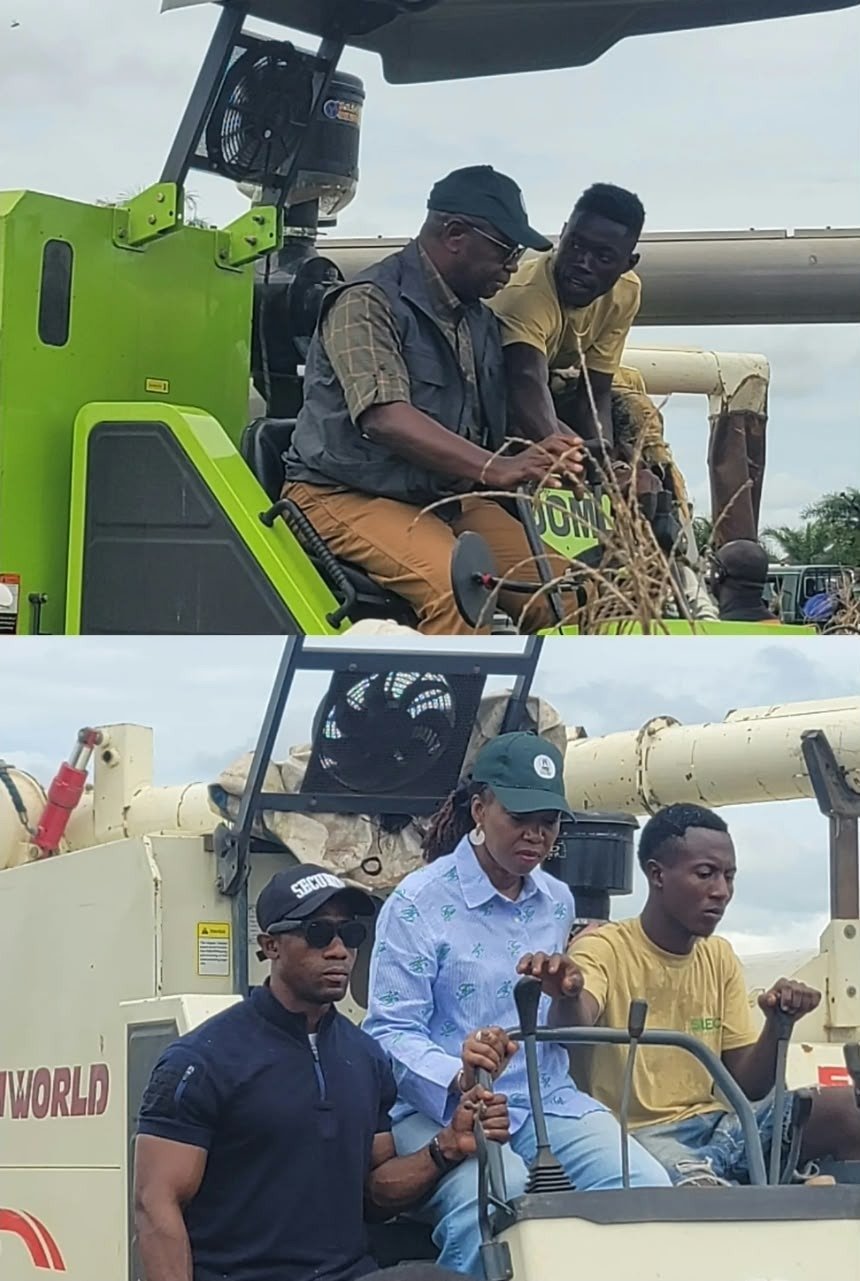
President Julius Maada Bio has renewed his government’s commitment to agricultural transformation and national food security after performing symbolic harvests of maize cultivated by SLENC Limited and rice produced by the Republic of Sierra Leone Armed Forces (RSLAF) in Moyamba District on Saturday, 17 October 2026, in a major demonstration of the growing momentum behind the Feed Salone initiative.
The presidential visit to Bai Largo in Kori Chiefdom, where SLENC Limited is cultivating maize, and the military rice farm at Yoni, Kamajei Chiefdom, highlighted the increasing contribution of private agribusinesses and the armed forces to Sierra Leone’s drive to reduce dependence on imported food, expand domestic production, create employment and strengthen rural livelihoods.
The two agricultural projects reflect the government’s determination to transform farming from predominantly subsistence activity into a commercially viable sector capable of supporting industrial growth, improving household incomes and securing sustainable food supplies for the country.
President Bio, who has consistently identified agriculture as a strategic priority of his administration, commended the farmers, the Ministry of Agriculture and Food Security, and the military for their contributions to the national food production agenda. He also called on young people to embrace farming as a business and urged the government’s agricultural institutions to provide farmers with the technical support required to expand production.
SLENC Limited Demonstrates the Potential of Commercial Maize Production
At Bai Largo in Kori Chiefdom, President Bio performed a symbolic harvest of maize cultivated by SLENC Limited, an integrated Sierra Leonean agribusiness company that grows, aggregates, cleans and processes grain through its own farming operations and a verified network of outgrowers.
The company’s activities demonstrate how commercial agriculture can connect production, quality assurance and processing while providing opportunities for local farmers, particularly women, to participate in the agricultural value chain.
Speaking during the visit, SLENC Chief Executive Officer, Ing. Sheriline Cowan, disclosed that the company had cultivated approximately 120 hectares of maize over the years, describing maize production as one of the major challenges facing the business.
She explained that SLENC had progressed from its initial operations in Songo to its current agricultural activities in Kori Chiefdom, building a farming operation that works with more than 200 people, over 60 percent of whom are women.
The company’s participation in the Feed Salone programme represents an important contribution to the expansion of domestic maize production, especially as Sierra Leone seeks to strengthen its poultry industry and reduce its reliance on imported feed ingredients.
Cowan said she was encouraged by the President’s visit, noting that his presence and support could inspire young people, particularly women, to invest in agriculture and pursue farming as a sustainable business.
She further disclosed that SLENC had access to a total of 500 hectares of farmland and expressed the need for irrigation facilities and support to increase the acreage under cultivation.
Her remarks highlighted the importance of agricultural infrastructure in enabling farmers to move beyond seasonal production and cultivate larger areas with greater efficiency. Reliable irrigation, access to improved farming technologies and technical assistance can help reduce exposure to irregular rainfall, improve yields and strengthen the commercial viability of farming enterprises.
SLENC’s operations also incorporate grain-quality controls, including aflatoxin testing, moisture measurements and visual grading before delivery. These measures are important for improving grain quality, protecting consumers and supporting the supply of suitable raw materials to food processors and livestock-feed producers.
The company also emphasises climate-smart agricultural practices, water stewardship and the adoption of cleaner energy solutions, including solar-powered systems.
With women accounting for more than 60 percent of its outgrower network, SLENC offers an example of how agricultural investment can contribute to women’s economic participation while supporting domestic food production.
The company has also received national recognition and awards from President Bio for its contribution and commitment to agricultural development.
Agriculture Minister Highlights Expansion of Maize Production
Minister of Agriculture and Food Security, Dr. Henry Musa Kpaka, said the government introduced the Feed Salone programme’s maize-production drive partly to support poultry farmers, whose businesses depend on reliable supplies of feed ingredients.
He disclosed that more than 80,000 hectares of maize had been cultivated since the previous year, pointing to the growing scale of efforts to increase domestic agricultural output.
The Minister identified the military among the country’s major agricultural producers, highlighting its ongoing cultivation of rice and cashew as evidence that institutions outside the traditional farming sector can contribute meaningfully to national food security.
He thanked SLENC Limited for its work and contribution to the government’s agricultural agenda, stressing the importance of private-sector participation in expanding production and strengthening the country’s food systems.
The expansion of maize cultivation is particularly significant because poultry production depends heavily on feed availability and affordability. Increased local maize production could help poultry farmers obtain more reliable supplies, reduce exposure to international market disruptions and support the development of a stronger domestic livestock industry.
A successful expansion of maize production would also create opportunities for grain aggregators, transport operators, processors, input suppliers and rural communities engaged in farming and related commercial activities.
However, sustaining this progress will require continued investment in improved seeds, fertilisers, mechanisation, storage facilities, irrigation, extension services and reliable markets for harvested produce.
President Bio Calls for Bigger Investment in Agriculture
President Bio praised Cowan for her leadership and described her agricultural investment as an encouraging example of young Sierra Leoneans responding to the national call to produce more food locally.
He also commended other farmers who have embraced the Feed Salone initiative, emphasising that maize is a critical component of poultry farming and therefore an important contributor to the country’s wider food-security objectives.
The President congratulated the Ministry of Agriculture and Food Security for its efforts and reiterated his desire to see agriculture thrive through increased domestic production and investment.
He called on Sierra Leoneans to think bigger about farming and to embrace commercial agriculture as a pathway to improved livelihoods, employment creation and economic growth.
President Bio further urged the Ministry of Agriculture and Food Security to strengthen the deployment of agricultural extension workers to provide farmers with the technical knowledge and practical support needed to improve productivity.
Extension workers play a critical role in transferring improved farming techniques, advising on pest and disease management, promoting soil conservation, encouraging appropriate fertiliser use and helping farmers adopt climate-smart production methods.
For commercial farmers such as SLENC, access to technical support and irrigation could prove particularly important in expanding cultivated acreage and improving production consistency.
The President pledged his government’s support for the project and encouraged young people to work hard, invest in farming and recognise agriculture as a viable business rather than merely a subsistence activity.
Paramount Chief Thomas Gbappi of Kori Chiefdom welcomed President Bio and his delegation to the chiefdom, expressing appreciation for the development initiative and encouraging the President to continue supporting programmes that improve the welfare of local communities.
The visit also brought attention to the potential for agricultural investment to generate rural employment, stimulate local trade and strengthen the economic position of chiefdoms through productive use of farmland.
Military Rice Farms Strengthen the National Food-Security Agenda
Following the maize harvest at Bai Largo, President Bio performed a symbolic rice harvest at the RSLAF’s military rice farm at Yoni, Kamajei Chiefdom, in Moyamba District.
The military agricultural initiative represents an important component of the government’s broader effort to improve food security, strengthen institutional self-reliance and reduce the country’s dependence on imported rice.
President Bio expressed satisfaction with the scale of cultivation at the military farm and commended the RSLAF for investing in modern agricultural equipment, including combine harvesters, to improve harvesting efficiency.
He was particularly encouraged by the extensive area of rice under cultivation, which is intended to help meet the food requirements of military personnel while contributing to the national agricultural transformation agenda.
The President encouraged other farmers and agricultural institutions to learn from the military’s example, adding that his government remained committed to supporting initiatives that increase local food production.
Mechanised harvesting can reduce labour constraints, improve operational efficiency and help farmers complete harvesting within appropriate periods. When combined with effective drying, storage and distribution systems, such investments can also help reduce post-harvest losses.
The military’s agricultural activities are anchored in a broader institutional commitment to contribute to national development alongside its primary responsibility for national security.
RSLAF Implements First National Defence Policy and Strategy
Section 165(1) and (2) of the Constitution of Sierra Leone Act No. 6 of 1991 establishes the constitutional framework for the RSLAF’s national security and national development mandates.
Following the appointment of Lieutenant General Amara Idara Bangura as Chief of Defence Staff on 19 November 2024, the Ministry of Defence and RSLAF leadership developed the country’s first National Defence Policy and Strategy in 2025.
The policy was officially launched by President Bio, Minister of Defence and Commander-in-Chief of the Armed Forces, during the 17th Armed Forces Day celebrations on 18 February 2026.
Under paragraph 4.2 of the National Defence Policy and Strategy, the Ministry of Defence and RSLAF committed themselves to contributing to national development through areas including cash-crop and livestock farming, civil engineering and construction, and healthcare delivery.
In agriculture, the military pledged to strengthen its farming operations to improve food security for military personnel and, where feasible, other security agencies.
The initiative is also intended to support the government’s Feed Salone programme, one of the flagship priorities within the administration’s Big Five Game Changers development agenda.
Deputy Minister of Defence, Colonel (Rtd.) Muana Brima Massaquoi, has said the military’s food-security and agricultural-transformation drive is aligned with Feed Salone and affirmed the Ministry of Defence’s commitment to working with the Ministry of Agriculture and Food Security.
Reducing dependence on imported rice could ease pressure on foreign exchange and public resources over time, provided domestic production becomes sufficiently productive, reliable and cost-effective to meet a growing share of demand.
4,837 Acres Cultivated Across Six Locations
In March 2026, the Ministry of Defence and RSLAF cultivated a reported total of 4,837 acres of rice and cashew farms across six locations in Sierra Leone.
The programme covers the following sites:
Makallay, Bakeh Loko Chiefdom, Port Loko District: 565 acres of cashew.
Mankara, Bakeh Loko Chiefdom, Port Loko District: 215 acres of rice.
Rumbeh, Kama Soto Chiefdom, Port Loko District: 366 acres of rice.
Masang, Mamoutha Mayosoh Chiefdom, Tonkolili District: 691 acres of rice.
Yoni, Kamajei Chiefdom, Moyamba District: 1,500 acres of rice.
Tormabum, Bum Chiefdom, Bonthe District: 1,500 acres of rice.
These figures underline the scale of the military’s agricultural ambitions and the potential contribution of institutional farming to national food production.
President Bio previously visited and inspected the Tormabum farm site on 1 August 2026, expressing appreciation to the Ministry of Defence and RSLAF leadership for their efforts.
On 2 October 2026, a cross-section of retired generals and senior military officers also visited and inspected various farm sites, expressing amazement at the growth of the rice and cashew crops.
The latest symbolic harvest at Yoni on 17 October further demonstrated the administration’s interest in monitoring the progress of these agricultural investments.
A Shared Commitment to Feed Salone
The combined activities of SLENC Limited and the RSLAF illustrate how private enterprise and public institutions can contribute to the same national objective through different but complementary approaches.
SLENC’s maize production supports the potential development of local poultry-feed supply chains, while the military’s rice cultivation focuses on institutional food security and wider agricultural transformation.
Both initiatives highlight the importance of productive land use, mechanisation, private investment, employment opportunities and stronger links between farmers and domestic markets.
Nevertheless, translating increased acreage into lasting food security will depend on actual yields, production costs, post-harvest management, market access and the availability of appropriate infrastructure.
For SLENC, irrigation and expansion of cultivated acreage remain important priorities. For the military, maintaining machinery, managing large farms efficiently and establishing reliable harvesting, storage and distribution systems will be essential to sustaining production.
The Ministry of Agriculture and Food Security will also have a key role in coordinating technical assistance, improving agricultural services and connecting producers with processors and buyers.
President Bio’s visit to Moyamba therefore served not only as a symbolic celebration of the harvest but also as a call for sustained investment and practical collaboration across the agricultural sector.
As Sierra Leone continues to pursue the Feed Salone agenda, the progress made at Bai Largo and Yoni offers an encouraging demonstration of what coordinated agricultural investment can achieve.
The broader challenge will be to build on these initiatives, expand successful production models and ensure that increased agricultural output translates into affordable food, stronger rural incomes, employment for young people and a more resilient national economy.