
DIB SURGES FOR A JUST SIERRA LEONE
By Ibrahim Alusine Kamara (Kamalo)
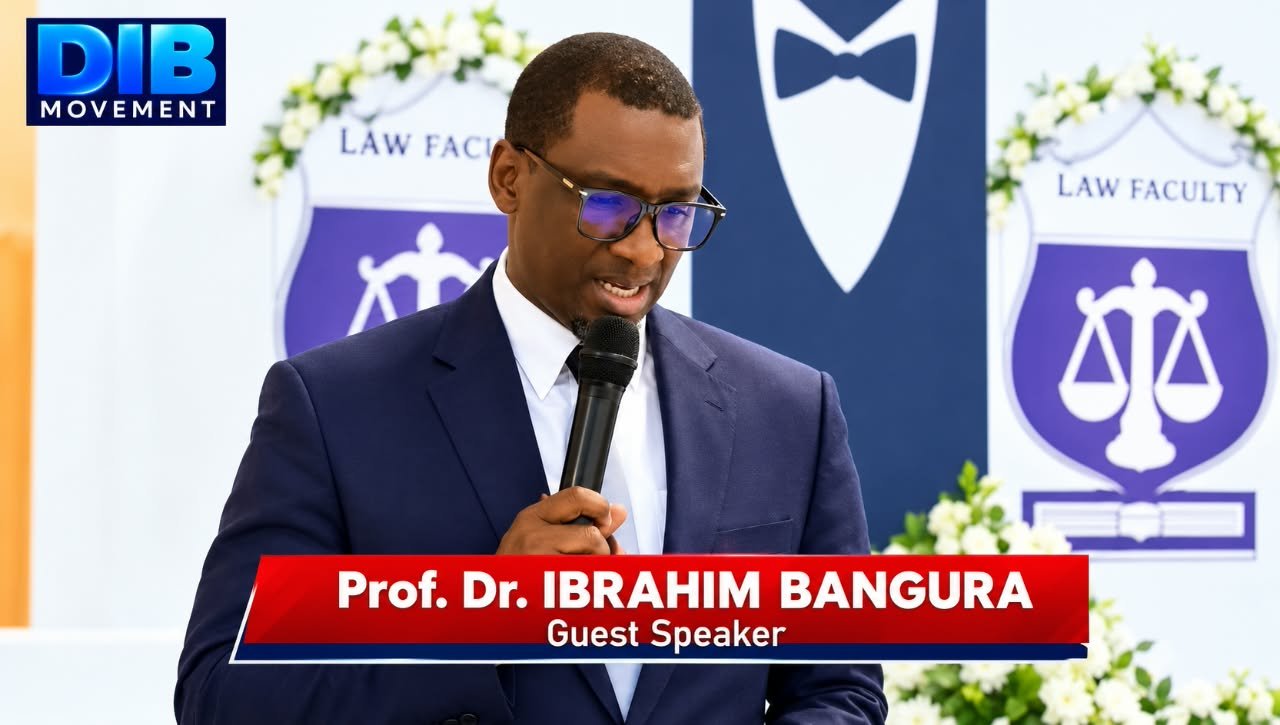
Prominent All People’s Congress (APC) flagbearer aspirant, Prof. Dr. Ibrahim Bangura, has delivered a powerful message on democracy, justice, accountability and national reconciliation, declaring that elections alone cannot guarantee genuine democracy without strong institutions, respect for human rights and equal access to justice.
Delivering a keynote address titled “The Soul of Democracy: Bridging Law, Justice, and National Resilience,” Dr. Bangura challenged Sierra Leoneans, particularly political leaders and those entrusted with public authority, to recognise that the strength of a democratic society must be measured not merely by the existence of laws and electoral processes, but by the fairness, accountability and justice those institutions deliver to ordinary citizens.
In a thought-provoking presentation, the APC presidential hopeful warned against confusing the existence of laws with the administration of justice, arguing that even authoritarian governments can operate within established legal frameworks while denying citizens their fundamental rights.
“Not all light is guidance. Not all law is justice,” he declared, stressing that justice remains the moral foundation upon which credible democratic institutions must be built.
According to him, laws without justice become instruments of bureaucracy and oppression, while justice without legal structures risks descending into disorder.
“Justice is what gives the law its soul. Law without justice is bureaucracy. Justice without law is chaos, but together, they are hope,” Dr. Bangura stated.
He explained that a functioning justice system must provide hope to the poor, protect citizens against abuses of power and ensure that no individual, regardless of political influence, wealth or social standing, is above the law.
Reflecting on Sierra Leone’s troubled history, Dr. Bangura recalled the devastating consequences of the country’s civil conflict, institutional breakdown, exploitation and injustice, noting that the nation’s experiences should serve as a permanent reminder of the dangers associated with weakened democratic institutions.
He maintained that Sierra Leoneans understand the painful consequences of a society in which weapons become more powerful than constitutional authority, corruption replaces accountability and citizens lose confidence in institutions established to protect them.
However, he expressed optimism that the country’s resilience, demonstrated through its post-war recovery and transitional justice mechanisms, provides a foundation for strengthening democracy and rebuilding public trust.
Drawing attention to the Special Court for Sierra Leone and the Truth and Reconciliation Commission, Dr. Bangura described both institutions as important examples of the country’s efforts to confront its painful past through accountability, reconciliation and restorative justice.
He argued that justice must not be viewed exclusively through punishment, but should also serve as an instrument for healing divisions, restoring dignity and building lasting peace.
“The law can be a healer, but justice can be a bridge between pain and peace,” he emphasised.
The APC flagbearer aspirant further challenged the perception that law should remain disconnected from the everyday struggles of ordinary Sierra Leoneans, insisting that legal protections must be accessible and relevant to citizens irrespective of their circumstances.
He cited the experiences of women struggling to secure inheritance rights, young people seeking fair trials and journalists exposing wrongdoing as practical examples of situations in which the law must protect citizens rather than intimidate or silence them.
“In every newsroom where a journalist dares to expose truth, the law must show up not as a weapon, but as a shield,” he asserted.
His remarks underscored the importance of press freedom, judicial independence, due process and the protection of fundamental human rights as essential ingredients of a functioning democracy.
Turning to democratic governance, Dr. Bangura warned that periodic elections, although important, are insufficient to guarantee a democratic society where accountability, fairness and respect for constitutional rights are absent.
“Too often we confuse democracy with voting. But elections alone do not create a democratic society,” he stated.
He maintained that countries could conduct elections, establish parliaments and adopt constitutions while still failing to uphold the principles that give democracy its meaning.
According to him, genuine democracy manifests itself in the everyday treatment of citizens, including respect for the rights of detained persons, protection against unlawful eviction and impartial adjudication of disputes.
“Democracy is not a destination, it is a discipline. And justice is its most sacred expression,” Dr. Bangura declared.
He also warned that declining public confidence in the justice system could have serious implications for national peace, stability and democratic consolidation.
When citizens lose faith in the ability of courts and law enforcement institutions to deliver justice, he explained, they may become reluctant to report crimes, resort to settling disputes outside established legal procedures or withdraw entirely from civic participation.
Such developments, he cautioned, could create conditions favourable to authoritarianism and undermine the democratic gains Sierra Leone has achieved since the restoration of peace.
Dr. Bangura consequently called for a justice system that is accessible, impartial, principled and responsive to the needs of ordinary citizens, stressing that the responsibility for defending democratic values extends beyond government institutions to every member of society.
He urged legal practitioners, political leaders, public officials and citizens to remain committed to justice even when defending its principles becomes politically inconvenient or personally costly.
His address also reinforced the central message of his political movement, which advocates healing divisions, uniting the APC and building a stronger Sierra Leone.
Through his widely promoted “Heal, Unite, Build” philosophy, Dr. Bangura has consistently positioned national reconciliation, political inclusiveness and institutional strengthening as important elements of his political vision.
The latest address appeared to extend that philosophy beyond internal APC politics to the broader challenges confronting Sierra Leone’s democratic development, particularly the need to restore confidence in public institutions, promote equal justice and strengthen national cohesion.
For a country still navigating political polarisation, governance challenges and demands for institutional accountability, his message placed justice and the rule of law at the centre of the national conversation on democracy and sustainable development.
Dr. Bangura concluded by reaffirming the commitment of the DIB Movement to strengthening the APC while promoting a more united, peaceful and prosperous Sierra Leone.
“Welcome to the DIB Movement, where together we are committed to healing, uniting, and building a stronger APC and a better Sierra Leone,” he declared.
His address ultimately presented a vision of democratic leadership in which political power must be exercised with restraint, institutions must operate without discrimination and the protection of citizens’ rights must remain paramount.
The central message was unmistakable: Sierra Leone’s democratic future must be built not merely on the conduct of elections or the existence of laws, but on justice, accountability, national reconciliation and institutions that protect every citizen, regardless of political affiliation or social standing.