
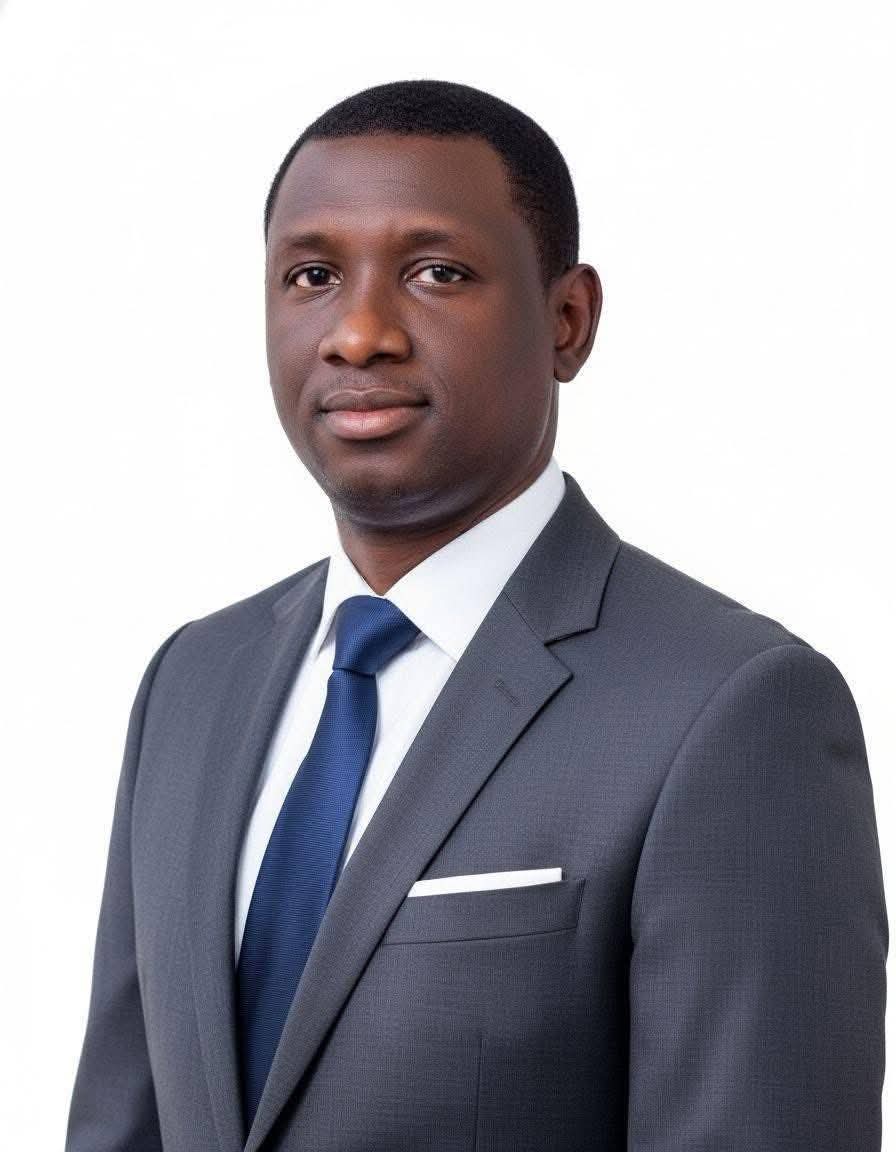
Early Signs of Dr. Ibrahim Bangura’s Compassionate Leadership
By Jarrah Kawusu-Konte
It is during moments of crisis that nations witness character that is pure, empathetic and visionary. And sometimes, it is in the immediacy of tragedy that true leadership reveals itself through instinct.
When a devastating fire tore through the office of Mohamed Asmieu Bah, Deputy Director General at the Sierra Leone Broadcasting Corporation (SLBC), the loss was total: Laptop, documents, cash, personal effects, the very instruments of professional life reduced to ash within minutes. His own words, raw and unfiltered, captured the trauma of that moment, a man stepping out of a routine meeting into the sudden violence of flames consuming his workspace, his tools, his order.
In that fragile window between shock and response, when institutions often hesitate and officialdom calibrates its optics, one figure moved with clarity and purpose: Dr. Ibrahim Bangura.
Without the inertia that too often defines public response, Dr. Bangura arrived at the scene not as a spectator of misfortune, but as a participant in relief. His visit to SLBC was an intervention of leadership that truly cares. A gesture anchored in both empathy and pragmatism – $5,000 donation and the provision of laptops, tools of restoration.
This is where the distinction lies.
Political theorists in contemporary governance have long drawn a line between formal authority and legitimate leadership. Authority waits. Leadership anticipates. Authority reacts. Leadership intuits. What unfolded at SLBC was the reflex of understanding, an ability to read both the event and the human condition within it.
Dr. Bangura understood that the fire had consumed more than property. It had disrupted cognitive stability, professional continuity, and emotional equilibrium. In crisis psychology, such moments demand what is termed “immediate stabilisation inputs”, interventions that restore both function and dignity. Cash provides agency. Tools restore productivity. Presence affirms humanity.
He delivered all three.
And he did so at a time when the national broadcaster, an institution central to Sierra Leone’s democratic conversation, stood vulnerable, its deputy director general stripped of the very means through which he contributes to public discourse. That Dr. Bangura recognised both the symbolic weight and the human urgency of that moment speaks to a rare political intelligence, one that fuses empathy with strategic awareness.
This DIB behaviour has become a much welcomed pattern.
Across his public life, Dr. Bangura has demonstrated what leadership theorists describe as situational responsiveness, the capacity to align action with the precise demands of a moment. It is a quality of his that is often claimed by others but rarely proven. Yet here, in the ashes of a burnt office, Bangura’s trademark compassionate leadership found tangible expression.
More striking, however, is the timing.
Before the machinery of state could mobilize its presence, before official visits could be scheduled and statements drafted, Dr. Bangura had already acted. In governance studies, speed of response is itself a metric of seriousness. Delay communicates distance. Immediacy signals ownership. And ownership is the currency of trust.
Sierra Leone today stands at a crossroads marked by economic strain, social fragmentation, and a growing distance between citizens and the structures meant to serve them. In such an environment, leadership cannot afford abstraction. It must be felt, seen, and experienced in real time.
Dr. Bangura’s intervention at SLBC was, in many ways, a microcosm of a broader proposition, that leadership is not an office to be occupied, but a responsibility to be exercised continuously, instinctively, and humanely. His oft-articulated mantra, healing, uniting, and building, flows in elegant fruition in moments like this as it translates into lived reality.
What sets Dr. Bangura apart is not merely that he acted, but how he acted. With decorum, without spectacle. With substance, not symbolism alone. In comparative political analysis, leaders who emerge in times of systemic strain often distinguish themselves through what is called “crisis empathy”, the ability to connect governance to the lived experiences of citizens. It is this quality that transforms administrators into statesmen.
And it is precisely this quality that Sierra Leone now requires.
Across regions, across ethnic identities, across political affiliations, there is a growing recognition that the country’s challenges demand more than routine governance. They demand leadership that can read the nation’s emotional temperature, anticipate its needs, and respond with both urgency and intelligence.
The fire at SLBC was an isolated incident. But the response it elicited was not isolated in meaning. It was a signal. A signal that within the current political landscape, there exists a figure whose instincts align with the demands of leadership, whose actions reflect preparation rather than improvisation, and whose vision appears grounded in an intimate understanding of the human realities that define national life.
If indeed coming events cast their shadows, then perhaps this moment, quiet yet profound, offers a glimpse into what a different kind of leadership could look like in Sierra Leone.
Not distant. Not delayed. Not detached.
But present. Perceptive. And purposeful.