
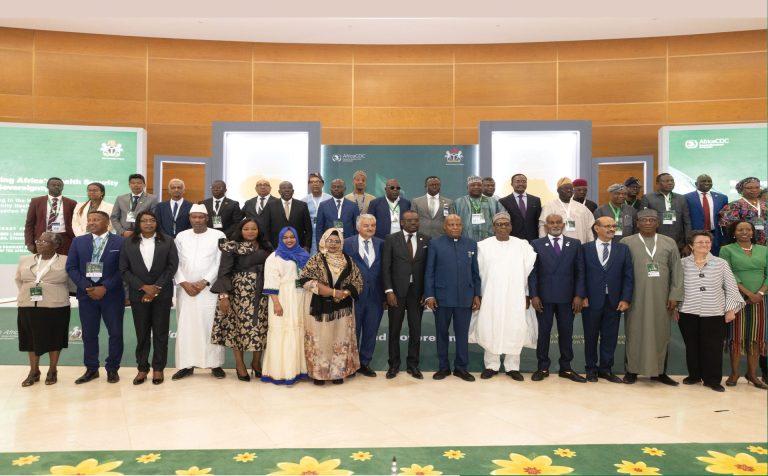
African Leaders Pledge Major Investment in Continent’s Health Workforce
By Yusuff Moseray Suma
African leaders have committed to significantly increasing investment in the continent’s health workforce, calling it essential to safeguarding Africa’s health security and achieving Universal Health Coverage (UHC) by 2030.
The commitment was made at a high-level meeting convened by the Africa Centres for Disease Control and Prevention (Africa CDC), the African Union Commission and the Government of Nigeria. Heads of delegation, ministers of health and finance, and senior African Union officials endorsed a call for urgent and sustained investment in human resources for health, including building a two-million-strong community health worker (CHW) workforce by 2030.
Leaders stressed that health investment is central to advancing Africa’s Health Security and Sovereignty agenda and accelerating progress toward UHC.
Speaking on behalf of the AU Champion for Human Resources for Health and Community Health Delivery Partnership, Nigerian President Bola Ahmed Tinubu said Africa cannot protect its citizens from pandemics or achieve universal health coverage without investing in its health workforce. “Sovereignty without standards is not sovereignty; it is exposure to risk,” he stated.
According to projections by the World Health Organization (WHO), Africa faces a shortfall of more than six million health workers by 2030. The deficit threatens progress in immunisation, outbreak detection and the delivery of essential primary health care, including maternal and child health services, chronic disease management and access to preventive and curative care. Although Africa bears more than 25 percent of the global disease burden, it continues to experience severe shortages of trained health personnel.
Closing the workforce gap, leaders noted, is critical to improving health outcomes and achieving universal health coverage across the continent.
Nigeria’s Coordinating Minister of Health and Social Welfare, Professor Muhammad Ali Pate, announced that the country aims to deploy 100,000 salaried community health workers nationwide by 2027, fully integrated into state health systems. He reiterated calls for CHWs to be formally recognised, regulated and professionalised within national health frameworks.
Data from Africa CDC’s Continental Health Workforce Investment Case indicates that every US$1 invested in the health workforce could yield up to US$19 in economic returns, while failure to act could cost the continent an estimated US$1.4 trillion by 2030. The report estimates that approximately US$4.3 billion annually will be required to build a two-million-strong CHW workforce by the end of the decade.
Africa CDC Director General Dr Jean Kaseya described investment in health workers as a strategic necessity rather than an expense, urging governments to accelerate and strengthen resource mobilisation for the sector.
Professor Julio Rakotonirina, Director for Health and Humanitarian Affairs at the African Union Commission, reaffirmed the Commission’s commitment to working with Member States and partners to advance professionalisation of the health workforce through a Continental Framework and Acceleration Plan.
A joint Africa CDC–UNICEF survey shows that 1.042 million community health workers were deployed across Africa in 2024. However, CHW density remains at 7.5 per 10,000 people—well below the benchmark of 25 per 10,000 set by Africa CDC as necessary to reach 70 percent UHC coverage by 2030. Only six countries currently finance more than 80 percent of their CHW programmes domestically, while just 16 countries offer structured career pathways.
In a communiqué adopted on 13 February 2026, leaders urged Member States to integrate health workforce financing into national budgets, protect frontline health spending and strengthen coordination between health and finance ministries. They also directed Africa CDC and the Continental Coordination Mechanism for Community Health to convene in Abuja before June 2026 to launch a Continental Acceleration Plan and support the replenishment of national acceleration plans for community health workers.
The meeting concluded with a unified call for sustained political commitment and domestic financing to build a resilient, well-trained and adequately supported health workforce capable of meeting Africa’s growing health challenges.